
Sarasvati

Updated: Dec 24, 2025

A major goddess
Sarasvati is one of the three principal goddesses of the Tridevi (the supreme trinity in its feminine form), alongside Lakshmi and Parvati. She is associated with the creator god Brahma, either as his creation or as his consort. As the goddess of knowledge and the arts—particularly music—tradition credits her with the invention of Sanskrit. Her mount is a white goose or a swan. Certain representations influenced by Indian iconography depict her with four arms, holding a lute (vina), a book or manuscript (pustaka), sometimes a rosary (aksamala), a sacred lotus (padma), or a water vessel (kamandalu).
Both sculptures discussed here depict Sarasvati riding a swan. In keeping with the formula that prevailed in Balinese sculpture prior to the final third of the twentieth century, the goddess is not shown with additional arms.

I Ketut Tulak – an interpretation in the slender style
The larger of the two works (42 cm in height) is signed by I Ketut Tulak, who also carved the figure of Ganesha discussed elsewhere on this blog. Probably dating from the 1960s or 1970s, it is carved from a light, pale wood covered with a brown patina. The treatment of the motif appears to derive from a sculpture executed between 1935 and 1940, a reproduction of which can be seen on the blog of collector Sipke van de Peppel. The elongating effect adopted by Tulak, together with his imaginative use of pronounced curves, recalls the variant of the slender style developed by I Made Runda, another important sculptor active during the same period.
The goddess presses against her chest what may be a padma. An elegant spiraling effect around a central void brings her face close to the head of the swan, suggesting an intimate connection between the goddess and her mount. Finally, it is worth noting that, echoing a solution found in certain earlier sculptures, Tulak evokes the surface of the water through a play of motifs—waves and vegetation—carved in shallow relief on the vertical base supporting the figures.
I Wayan Ratep – a balance between realism and idealization
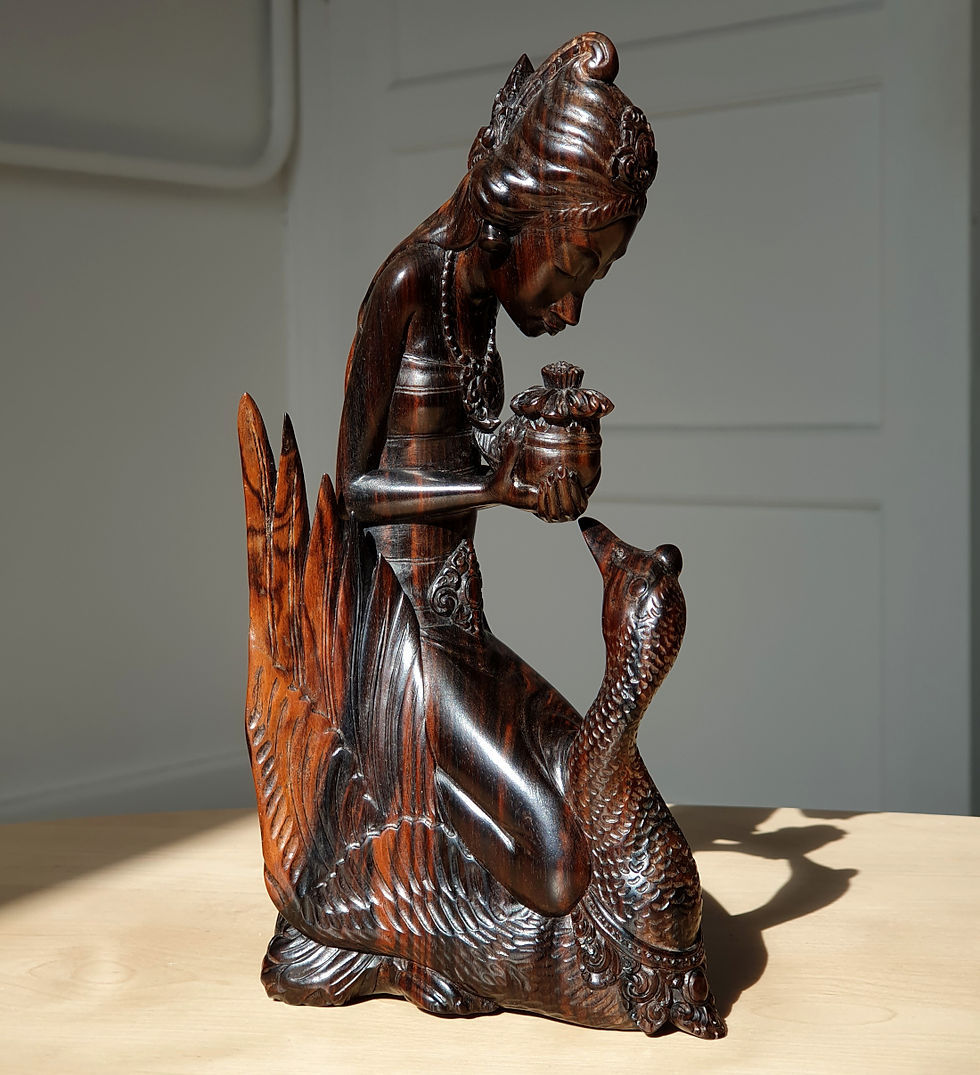
The second piece measures only 21 cm in height. Signed by I Wayan Ratep, it likely dates from the same period as the first. Ratep, however, offers a markedly different interpretation of the same subject. The wood—probably Macassar ebony—is dark, dense, heavy, and silky to the touch. Carving a small sculpture with such refined detailing in a wood that is both extremely hard and brittle is, in itself, a remarkable technical feat.
The goddess holds in her hands a kamandalu surmounted by an open padma, whose fragrance she appears to be inhaling. She is adorned with a belt, a Garuda mungkur–type hair ornament, a diadem, and a richly carved necklace. The swan, too, wears an ornate collar at the base of its neck. Ratep has opted for a treatment rooted in tradition, striking a subtle balance between realism and idealization. A varied network of fine incisions differentiates the textures of hair, petals, and feathers, while the reddish veins of the ebony seem to flow delicately across the surfaces, particularly accentuating the tips of the swan’s wings.


Comments