
"Balinese" Bronzes: The Indochinese Detour


Small bronze figures are occasionally found that strongly resemble certain Balinese wood carvings from the 1930s to the 1950s. The motifs are among those frequently encountered in modern Balinese sculpture: men or women at rest, Janger dancers, priests performing rituals, male or female busts... In many cases, however, these are not actually Balinese creations. As Koos van Brakel notes in his book Art Fallen from Heaven, the success of Balinese wood carvings was so great by the 1930s that some were reproduced in bronze in workshops located in French Indochina, and subsequently sold in Indonesia. Their production date therefore predates the French colonial withdrawal and the dissolution of French Indochina in 1954. Although they appear to have been distributed in fairly large quantities, these small bronzes are nonetheless quite difficult to find today.


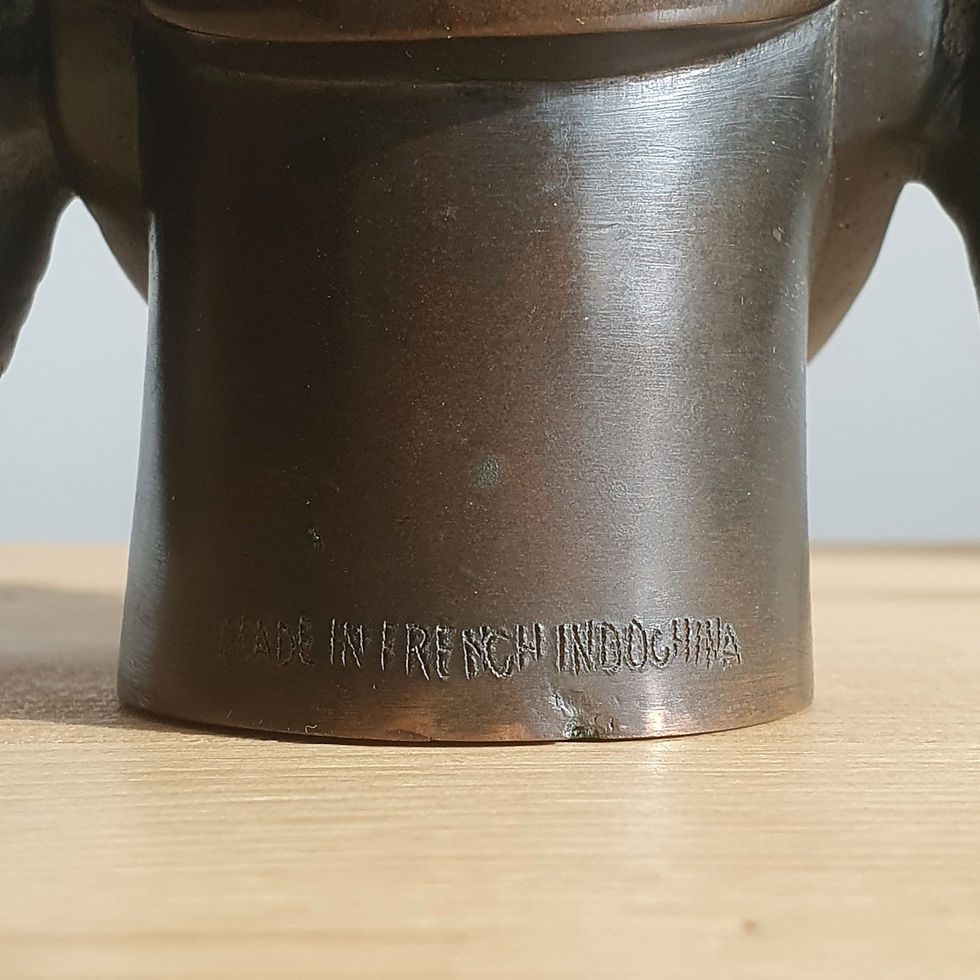
The two sculptures shown above represent a seated young man and the head of a priest. The lines are characteristic of the wayang style, which was popular during this period. Their significant weight relative to their size indicates that the metal casting is partially solid. Both bear the inscription "Made in French Indochina" at the lower back. The statue of the young man is similar to the one reproduced on page 54 of Frans Leidelmeijer’s book, Art Deco beelden van Bali (1930-1970), while an identical priest's head can be found on page 84 of Koos van Brakel’s book.
Much like certain Janger dancer busts found in various bronze formats, male busts seem to have been produced in considerable numbers. The one pictured below stands only 12.5 cm high. Although this specific piece lacks an inscription, it is nonetheless an Indochinese production, as evidenced by the presence of the marking on other busts of the same type occasionally found on the second-hand market.




Comments