
A Standing Female Figure in Wayang or "Art Deco" Style

Updated: Mar 9

Carved in the wayang—or "Art Deco"—style, this figure dates from the 1930s or 1940s. Likely due to the prevailing tastes of buyers at the time, seated figures are more commonly found in the wayang style than standing ones. Among the latter, one must distinguish between classical poses and rarer, sometimes unique variants. This piece may well be such a rarity; I have yet to encounter an equivalent.
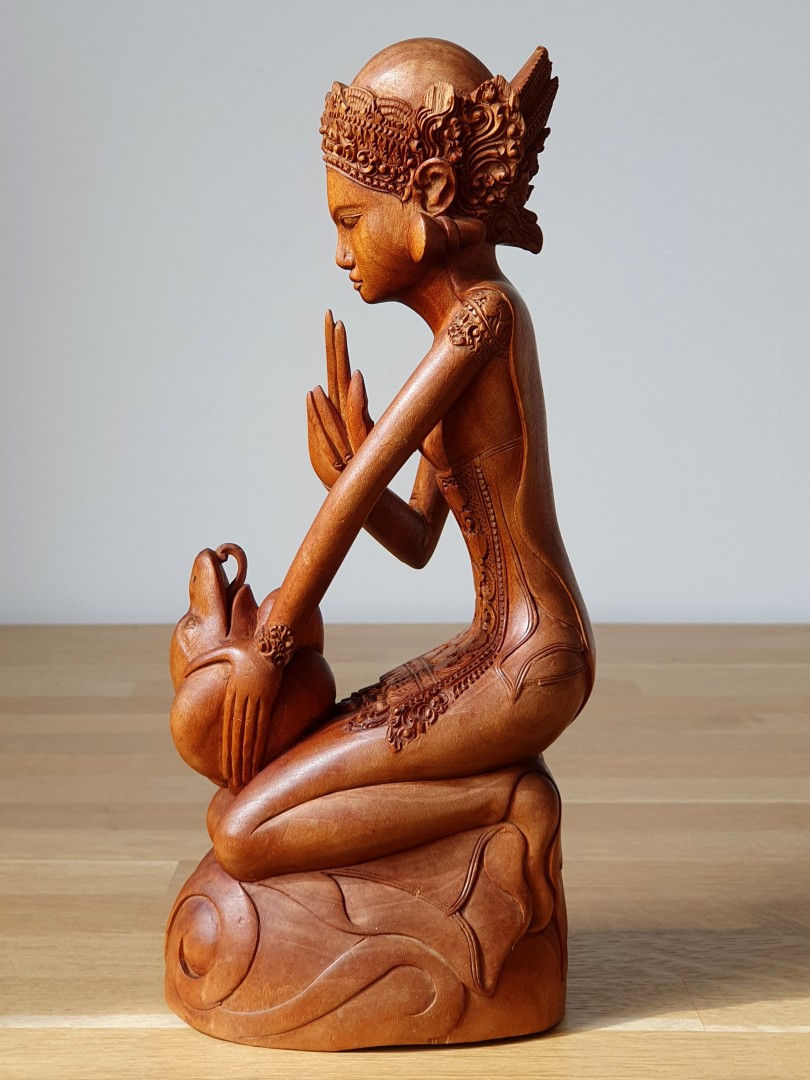
This is a female figure of substantial proportions (44 x 15 x 8 cm), carved from a light-colored, relatively heavy wood. The woman walks upon a rock-like base. Her "bulbous" hairstyle, typical of the wayang style, is wrapped in a scarf with intricate folds. She is bare-chested, clutching a voluminous object to her waist. Its shape resembles a cylinder or a truncated cone with a neck, topped by a broad, very short cone divided into triangular sections. Consultations with other collectors have not yielded a definitive identification of this object. However, the prevailing hypothesis is that it represents a traditional rice-cooking apparatus: a type of pot (dangdang) used to boil water, the steam from which cooks the rice held in a basket (kukusan) placed above it.


The almond-shaped eyes, high-set ears, and slender fingers are hallmark characteristics of the wayang style. Yet, beyond these standard features, the carver has treated the forms and proportions with an audacity that, to an observer familiar with Western art, evokes Cubist experimentation. The strangely raised shoulders place the head in direct continuity with the torso. The skull is significantly elongated, and the breast appears particularly broad. The positioning of the legs follows a strict play of diagonals, suggesting lateral movement and creating a geometry that is simultaneously frontal and dynamic. In the center of the lower section, the garment's hemline traces curves and counter-curves. While the pelvis, head, and torso are viewed from the front, the legs are positioned in profile. And while the left foot rests on the base as is customary in a sculpture in the round, the right, though viewed from above, is pressed frontally against the vertical surface of the base, in a manner more typical of a bas-relief.

When viewed from the side, the figure reveals itself to be very shallow. A glance at the underside of the base indicates that this thickness corresponds to the half-section of the log from which the piece was carved.

Given the Balinese carvers' aptitude for working with the natural qualities of wood rather than forcing them, it is reasonable to suggest that the characteristics noted above are largely dictated by the properties of the original block. Alongside a bold interpretation of the wayang style, the anchoring of movement within a dominant frontality—and the fusion of sculpture-in-the-round with bas-relief logic—reflects a creative appropriation of material constraints. The carver skillfully leveraged the shallow depth of the initial block to stimulate his formal inventiveness.



Comments