
The Collector’s Torments and Principles: An Introspective Parenthesis in the Form of Digressions

Updated: Jan 20

To acquire or not to acquire? This is the question the collector must regularly confront. But what decides him to answer yes or no? For example, this drummer he spotted on an online sales platform—should he adopt it? One might assume the matter is simple enough. A question of taste above all, framed by a few elementary practical considerations: is this drummer well-made? Does the collector truly like it? As it happens, he already owns a figure of the same type. Wouldn’t it be better to acquire something else? And then—regarding the practical side—does the collector have enough money? Enough space? He is careful to spend only reasonable sums (though, parenthetically, he must admit that in his practice, his definition of "reasonable" proves to be somewhat elastic). As for space, his preference—and he is firm on this—is for relatively uncluttered areas. A dull anxiety washes over him at the thought of living in a cramped apartment, like those cluttered warrens of certain collectors’ interiors he occasionally sees in photographs. For this reason, the growth of his collection exposes him to a kind of inner conflict. He casts a quick glance at his shelves, at his desk: no, he has not yet reached the critical stage.
There is the object, and there is the collector’s desire. The acquisition represents the success of the encounter between the two. Generally speaking, a collector’s desire is something special. It is, one might say, an obstinate desire. Where does this obstinacy find its source? Furtively, in his imagination, the collector sees himself again sitting on the rug of his childhood bedroom, his toys laid out before him. He remembers his grandfather, who passed away when the boy was only six, and who used to bring back objects from a distant land that, as he told himself at the time, had seen peoples and landscapes he would have liked to know. Who knows where our desires come from? Is there not always, in the act of collecting—in this repetition of the same gesture, in this accumulation of objects—something like an insistent need for reparation that slips through? The collector does not much like thinking about all that. Besides, on reflection, his activity is not so extravagant. It is merely a particular variety of repetitive behavior, which can be questioned like many others: do some not engage in daily physical activity to ward off the fear of passing time? Do others not devote their lives to activism to mask a sense of futility? And others still… but wait—it occurs to him just now—didn't Sigmund Freud himself collect statues of all kinds? One can see them in the photos of his study. And it is a fact that the collector’s desk is not as cluttered with statues as Sigmund Freud’s was.

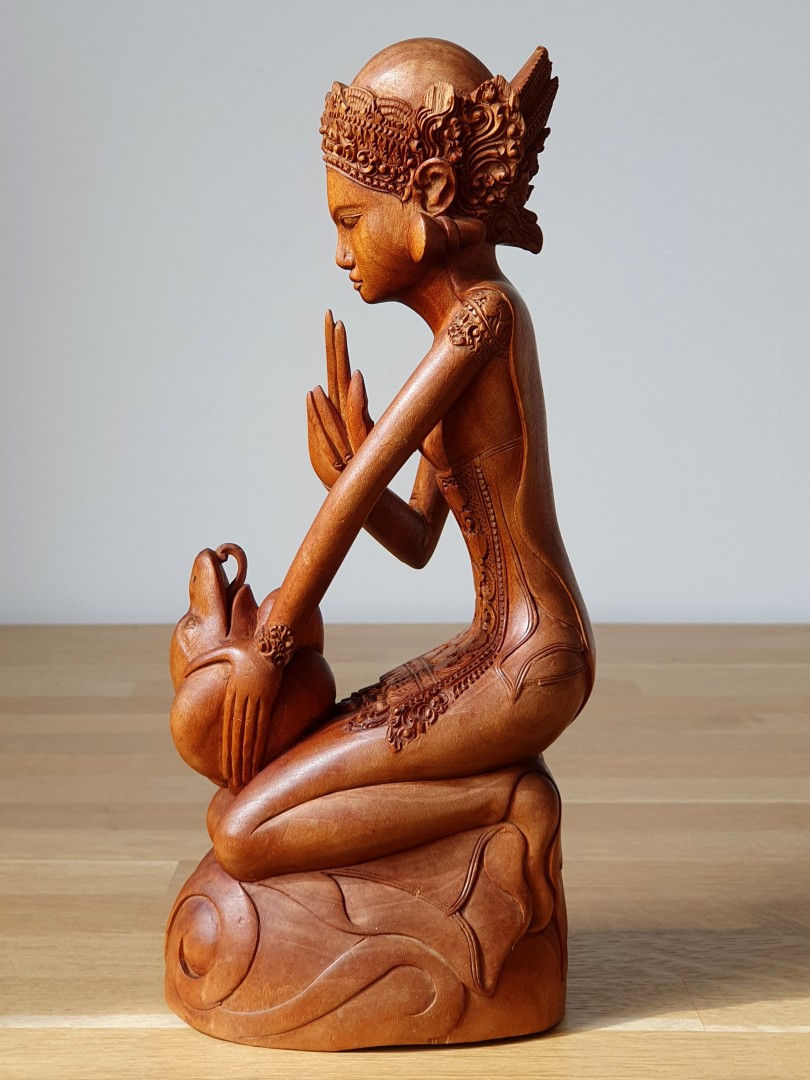
What, then, is collecting? All things considered, it is essentially engaging in a serious and sustained activity. And it is quite possible that any serious and sustained activity is never, at its core, anything more than a well-oriented mania. The collector has not read Freud, but he would be willing to bet that the man said something of the sort somewhere. That is a reassuring point of view, the collector tells himself. And thinking of Freud, he remembers that the Viennese doctor also owned a Balinese sculpture in his vast collection. A sculpture attributed to Ida Bagus Njana, featuring an unusual and very strange motif: a meditating ascetic beset by demons. Lucky man, that Freud! And it is proof, by the way, that it is worth collecting such objects.

The sculpture for which the collector’s heart is wavering is not a Njana, it’s true. But it is in the same wayang style; one could say it is a sculpture from the same family. The collector glances at the drummer already settled on his shelf. It must be admitted that, according to the images posted online by the seller, the candidate piece has some arguments in its favor: it is yet another variation on the typical motif of the cross-legged musician, a figure of good size that can be dated to between 1930 and the late 1950s. While the drummer on the collector's shelf is carved from an ordinary, light wood covered in a dark patina, this one presents a polished wood surface of a beautiful honey color with visible grain. The lines are very elegant, and the floral motifs—though limited to the front of an udeng rising in the shape of a flame—appear very meticulously rendered. Granted, this musician is not accompanied by a small keris, but the collector notes with satisfaction that it, too, features a slot at the back between the spine and the garment’s edge, intended to accommodate such an accessory. This confirms his conviction that these musician sculptures were often originally sold with a miniature keris, usually lost today.

If a collection is not the unbridled expression of a mania, it is because desire is channeled by reflection, nourishing a conscious approach. To be sure, there are people who seem to amass statues or other things without asking themselves many questions, but the collector would like not to be one of them. A collection, he tells himself, must be grounded in principles. Before Balinese statues, he collected other objects: 19th-century reliquary frames containing devotional pipeclay reliefs, and, above all, various types of anonymous photographs produced between 1850 and the end of the 20th century. These are categories that have the advantage of offering a nearly inexhaustible supply of available objects and containing, drowned in a mass of insignificant items, a small proportion of remarkable but often unnoticed pieces—some of which could, consequently, be acquired for a sum the collector would describe as reasonable. It must be said, however: his activity arouses perplexity in those around him. Why collect souvenirs brought back by others? And by tourists, no less? Works of art? Are you sure?... I haven't seen any in any museum. Yes, but there it is—that’s where we come to this question of principles. What interests the collector is precisely that: clearing a path through a poorly thrashed thicket, trying to see clearly in the twilight. What fascinates him, he would say, is the way judgment can question established valuation mechanisms and thus contribute, however modestly, to marking out a field whose artistic character remains largely ill-defined—unjustly underestimated, he would go so far as to say. This is, more or less, a guiding principle.
The collector rumbles through a drawer. He remembers that a few months ago, worried that his interest might scatter or that his collection might take on unreasonable proportions, he had scribbled a few rules on a piece of paper. Ah, here it is:
Rule No. 1: The collection is like an inventory. Seek to show the diversity of Balinese sculpture.
Rule No. 2: An inventory, but not a complete panorama. Focus on certain subjects or styles, leaving others aside.
Rule No. 3: Always attempt to acquire the highest quality possible. Acquiring a mediocre object because it is a bargain is not a good idea.
Rule No. 4: Do not acquire a sculpture whose motif is similar to one I already own, unless the new sculpture is of equivalent or superior quality.
Rule No. 5: Allow myself a limited number of exceptions to Rule No. 4.
Rereading these lines, things suddenly seem very clear to him: by applying Rules No. 2 to No. 4, and with a moderate use of Rule No. 5, his collection will one day reach its end through a natural exhaustion of possibilities. One simply needs to follow the process to its end. The end is certainly not far off. The new drummer—of better quality than the previous one, it's obvious to him now—is a step in the process, and there is still a little room on the shelf. And if that space isn't enough, the collector will simply push a few sculptures aside to install the new one on his desk. Just as Sigmund Freud did.


Comments