
What Makes a Fine Bust?
- Olivier

- 7 déc. 2025
- 3 min de lecture
Dernière mise à jour : 28 déc. 2025

Balinese busts have been among the most cherished souvenirs for visitors to the island since the 1930s. And it is undeniably in the first half of the 20th century that the finest pieces were produced—whether busts of women, men, young or old, or janger (or djanger) dancer busts with their wide headdresses decorated with floral motifs. Figures of young adults seem to have been the most popular. The best examples display a strong commitment to realism in portraying faces with grave, serene expressions. Most of these works were carved from a light-colored, fairly lightweight wood, later covered with a beautiful dark patina.

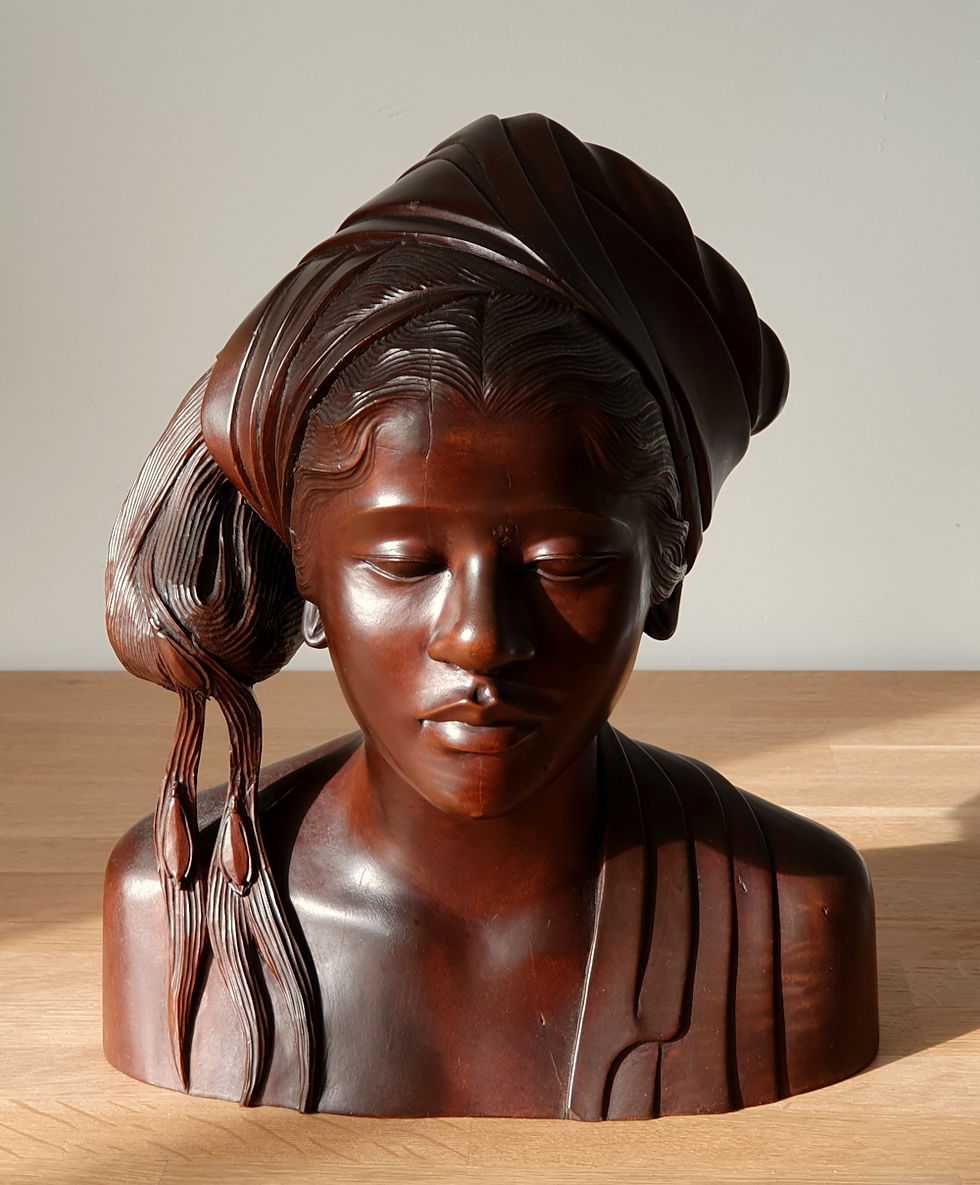
The two busts reproduced here date from the 1930s–1940s. The headdresses—traditional headbands tied on the head—are among the most commonly depicted: udeng for the young man, lelunakan for the young woman. These busts were often sold as pairs. Although this pair was likely matched from the beginning, they were made by different carvers, and a close look reveals a slight difference in style. They are also signed, which is rather uncommon for the period: “W.J.N. (I Wayan) Gog” for the female bust and “M. D. (I Made) Pait” for the male bust.
In their treatment, pieces of this type can evoke certain busts produced in the West between the Renaissance and the 20th century, which no doubt partly explains their appeal to visitors of the time. However, since these visitors wished to take home something recognizably Balinese, the carvers naturally favored a generic representation rather than a transcription of individual features. This is why all these Balinese busts share a kind of family resemblance. They embody the common pursuit of an ideal type of youth and beauty—a pursuit that emerges strongly in the work of the best carvers.
In the most accomplished pieces, however, the expression of the ideal can appear to borrow individual traits, to the point of approaching a portrait—though it is impossible to say whether this results from observing a model or simply from the carver’s imagination. Thus, in this young couple, the face of the young woman stands out for her large eyes and her short, slightly rounded nose, while the young man’s face is distinguished by prominent cheekbones and a rather fine chin.
A high-quality bust combines harmonious features with anatomical realism. Perhaps to make them easier to carry in a suitcase, busts of medium or lower quality often show a head that is somewhat flattened when viewed in profile. Personally, I pay close attention to whether the volume of the skull is fully developed in depth. The modeling should demonstrate an understanding of the underlying bone structure. In other words, the placement of raised and recessed forms should convey that the flesh is supported by the bone. For the same reason, I find it important that the eyes not appear as simple almond shapes with a raised border, but as globes set within the eye sockets, covered by the veil of the eyelid. The rendering of the ear’s complex form—when it is visible—is also a good indicator of quality.
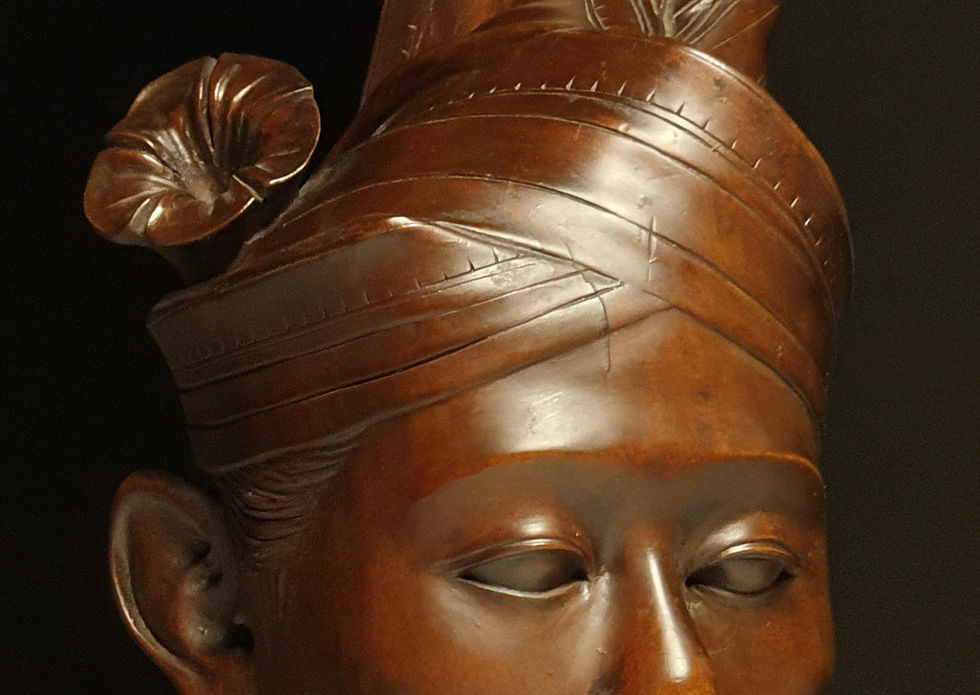

Finally, one can pay attention to the finish and to the treatment of certain ornamental details. In the couple reproduced here, this includes the delicate rendering of the flower in the male bust, and the careful depiction of the headdress’s folds and the hair’s waves in the female bust.