
Vishnu and the Churning of the Ocean of Milk


The sculpture was carved from a light-colored, lightweight wood – likely panggal buaya, or crocodile wood.
A male figure stands at the top of a rocky mass. He wears an ornate headdress and richly decorated garments. He performs a ritual gesture, holding a botanical element between his palms joined against his chest. A fantastical serpent figure, itself adorned with a headdress and ornate necklaces, coils around the rock and one of the male figure's legs. In the upper section, the end of the serpent's body rises, undulating into the air. The entire ensemble rests on a large turtle whose head, featuring a trunk-like snout, displays vaguely anthropomorphic features.
The group relates to a Hindu cosmological myth: the Churning of the Ocean of Milk (Samudra Manthana). According to tradition, this episode is narrated by the wandering bard Ugrashravas within a frame story that serves as the backdrop to the Mahabharata *. It takes place at a time when the gods (devas) and demons (asuras), both still mortal, are at war for dominion over the world. Exhausted and facing defeat, the gods turn to Vishnu for help. Vishnu suggests they collaborate with the demons to extract various treasures from the depths of the ocean, including amrita, the nectar of immortality. To accomplish this colossal task, the gods uproot Mount Mandara, turn it upside down, and place its peak upon the giant turtle Kurma, who is also an avatar of Vishnu. They wrap the body of the serpent Vasuki, king of the nagas, around Mount Mandara. Pulling one end of the serpent while the demons pull the other, they set the monumental assembly into rotation to churn the ocean. After long and grueling labor, the ocean turns to milk, then to clarified butter, releasing a multitude of wondrous beings and objects, as well as the amrita, which the gods eventually seize to gain immortality.
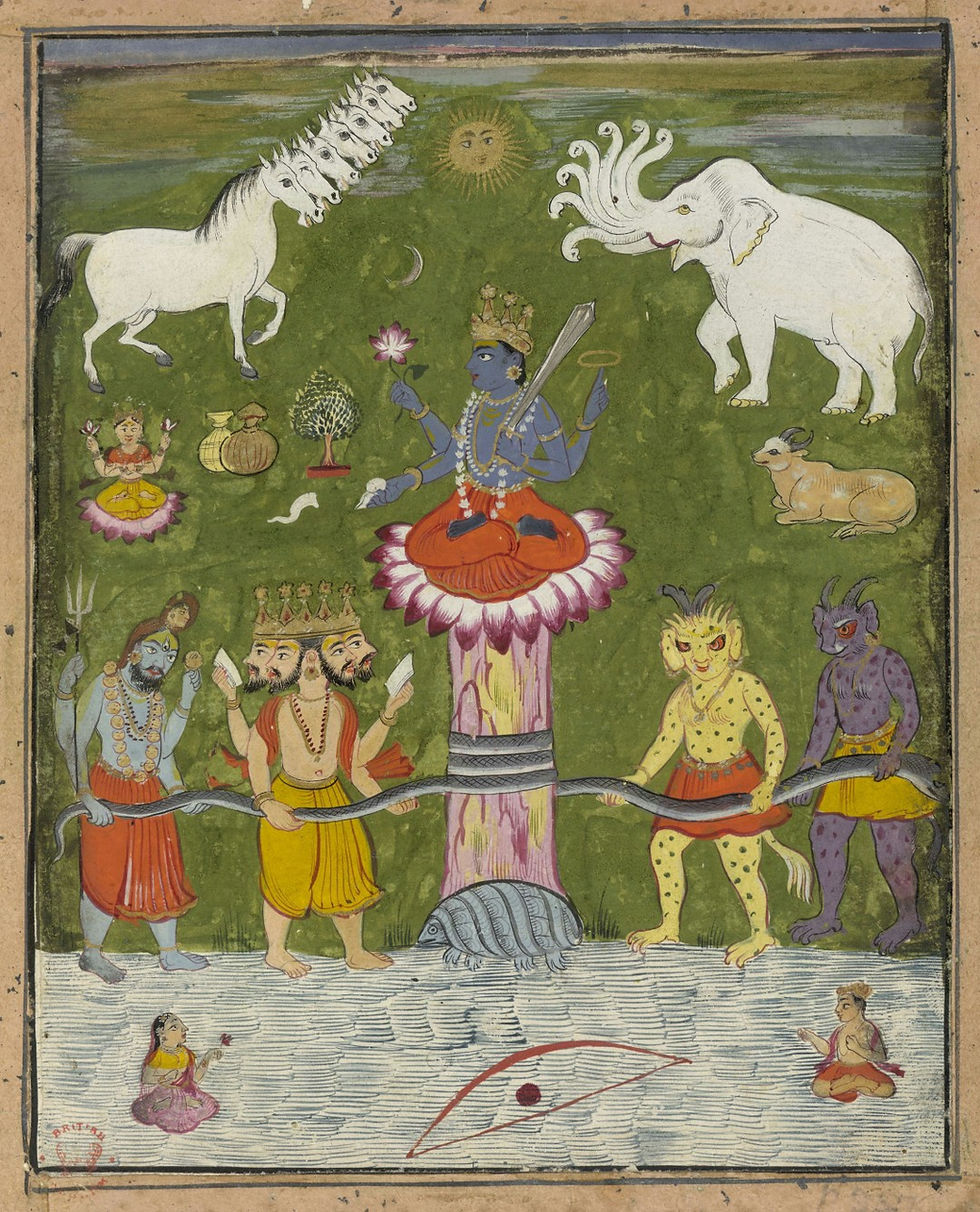
Shown below is a late 17th-century Indian painting depicting the scene of the Samudra Manthana. Vishnu is represented both as Kurma beneath Mount Mandara (evoked by a tall pink cylinder) and in human form at its summit. The gods (bottom left) and demons (right) hold the ends of the naga Vasuki. In the upper portion, several of the extraordinary beings born from the churning are visible, including – among many others – Uchchaihshravas, the seven-headed horse and mount of the sun god Surya; Airavata, the multi-trunked elephant and mount of the god Indra; Kamadhenu, the wish-fulfilling cow; and Kalpavriksha, the tree of perpetual bloom.
The key elements of the churning scene are easily recognizable in this Balinese sculpture: Vishnu in both his human and Kurma forms, Mount Mandara, and the serpent Vasuki. Despite its importance in Hindu tradition, this myth is, to my knowledge, rarely depicted in modern Balinese woodcarving. I was unable to obtain precise information regarding the date or acquisition context of this piece by its original owner. However, the fineness of the ornamental detail, the frontal and static posture of the god – reminiscent of the style seen in many traditional figures – and the double incision at the base of the fingernails (a detail frequently found in the wayang style) lead me to suspect it is the work of a sculptor trained in the first half of the 20th century.
* Hindu myths are complex and often exist in numerous variations. The summary provided here draws on French-language sources, notably on the version presented by Alexandre Astier in Les 100 Légendes de la mythologie indienne ("Que sais-je?" series, 2023) and on resources published online by the Bibliothèque Nationale de France.


Comments