
My Serpent, My Heart – Kadru, Kashyapa and the Nagas

In Hindu tradition, nagas are mythical beings that take the form of snakes. They have an ambivalent nature: the body of the naga Vasuki is used by the gods and demons to extract the nectar of immortality (amrita) during the Churning of the Ocean of Milk, but the venom of nagas can also bring death, and it is the bite of Takshaka, king of the nagas, that kills King Parikshit, leading his son Janamejaya to avenge him by organizing the great sacrifice of the serpents*. Nagas guard treasures buried in the earth. They are associated with water, rivers, lakes, the fertility of the soil, and fertility in general.
Kadru is the mother of the nagas. Like her sister Vinata, she is one of the wives of the sage Kashyapa. When he decides to grant each of them a wish, Kadru asks to give birth to a thousand children, the nagas, while Vinata wishes to have only two sons, but sons who will surpass Kadru’s children in strength. From Vinata’s first egg is born Aruṇa, who will become the charioteer of Surya, the Sun god; from the second is born Garuda, a divine being who is half-man, half-bird, and who will become the sworn enemy of his cousins and half-brothers, the thousand nagas born from Kadru’s eggs.
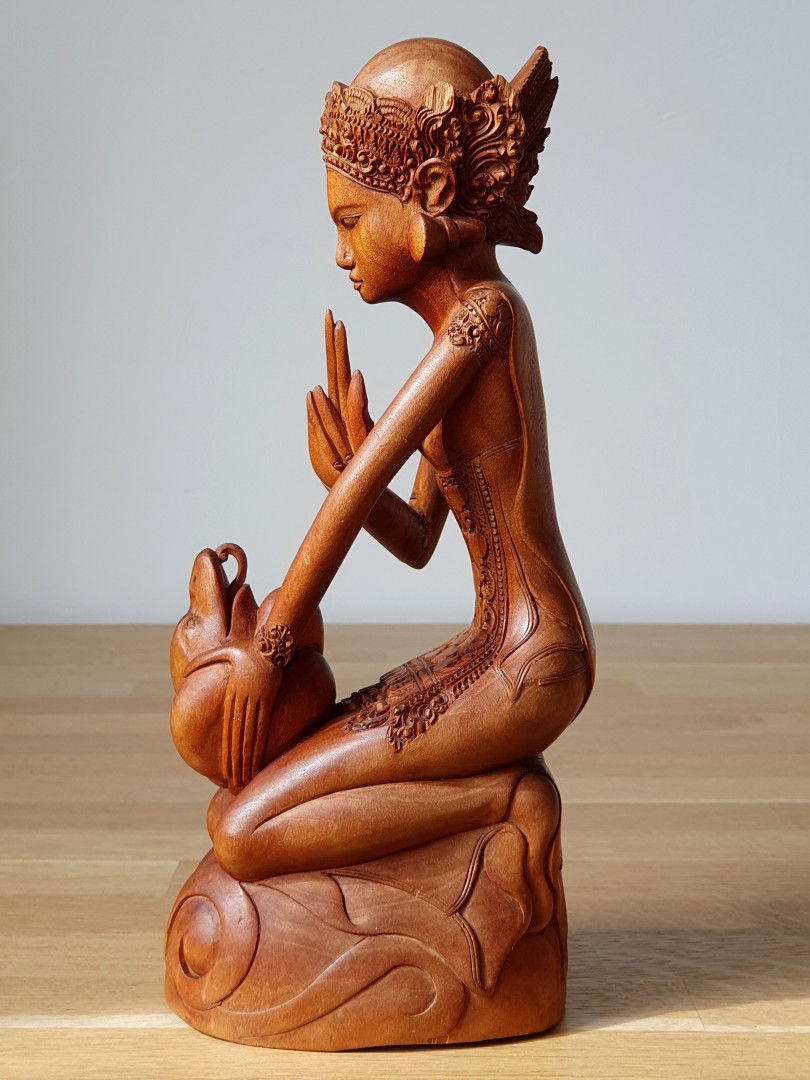
This sculpture depicts Kadru kneeling, her torso upright. In her left hand, she holds one of her children, coiled on her lap. Her right hand, raised above the naga with the index and middle fingers pointing upward, makes a gesture that is probably a mudra. Several features suggest that the sculpture was made in the first half of the 20th century: the hieratic pose, the finely worked ornaments on the headdress and clothing, the long hair covering the back and reduced to a simple, uniform ribbon-like form, and the double incision at the base of the fingernails.
On the base, the carver has placed a succession of very simple, slightly raised undulating bands. They may be understood as an evocation of the aquatic environment associated with the nagas. This way of suggesting water through curved motifs carved into a vertical base resembles the solution employed by Tulak in his representation of Sarasvati, to which I have already devoted an article.
Like many old pieces, this one has suffered some damage: several fragments are missing and the right arm has been reattached. It nevertheless remains remarkable for the quality of its treatment of forms and details, as well as for the rarity of the subject.
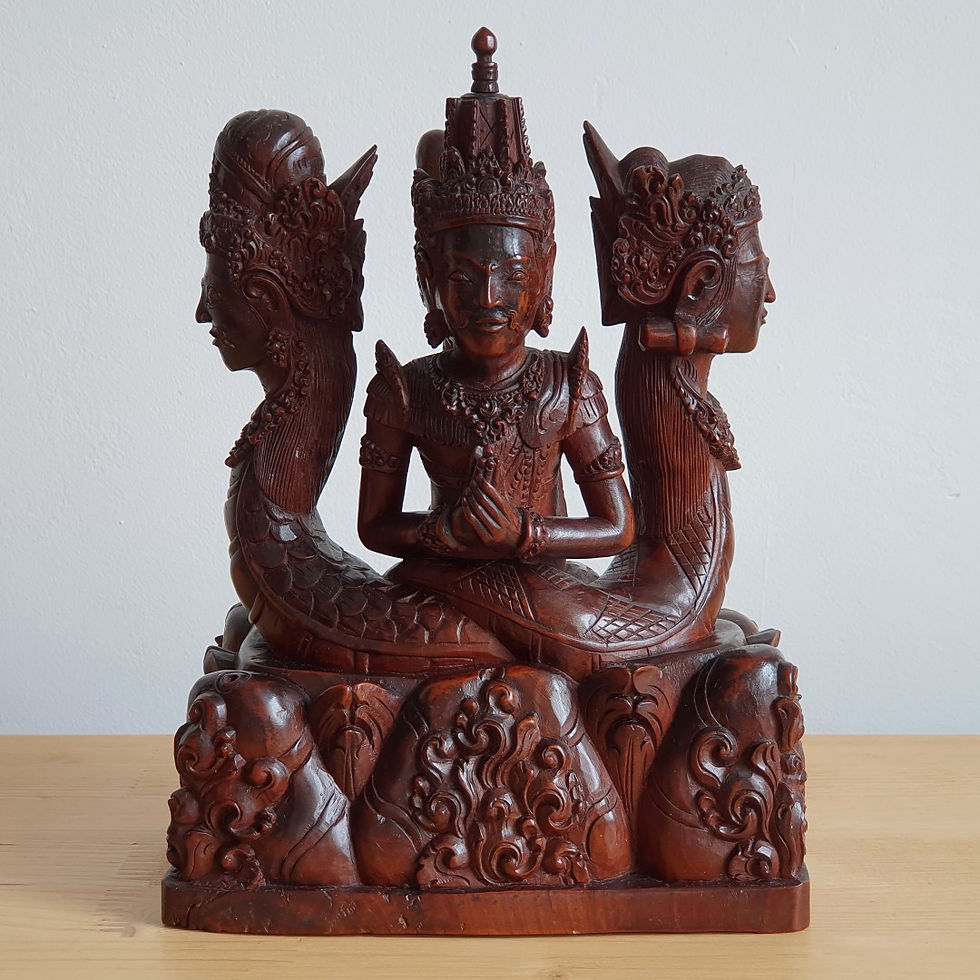
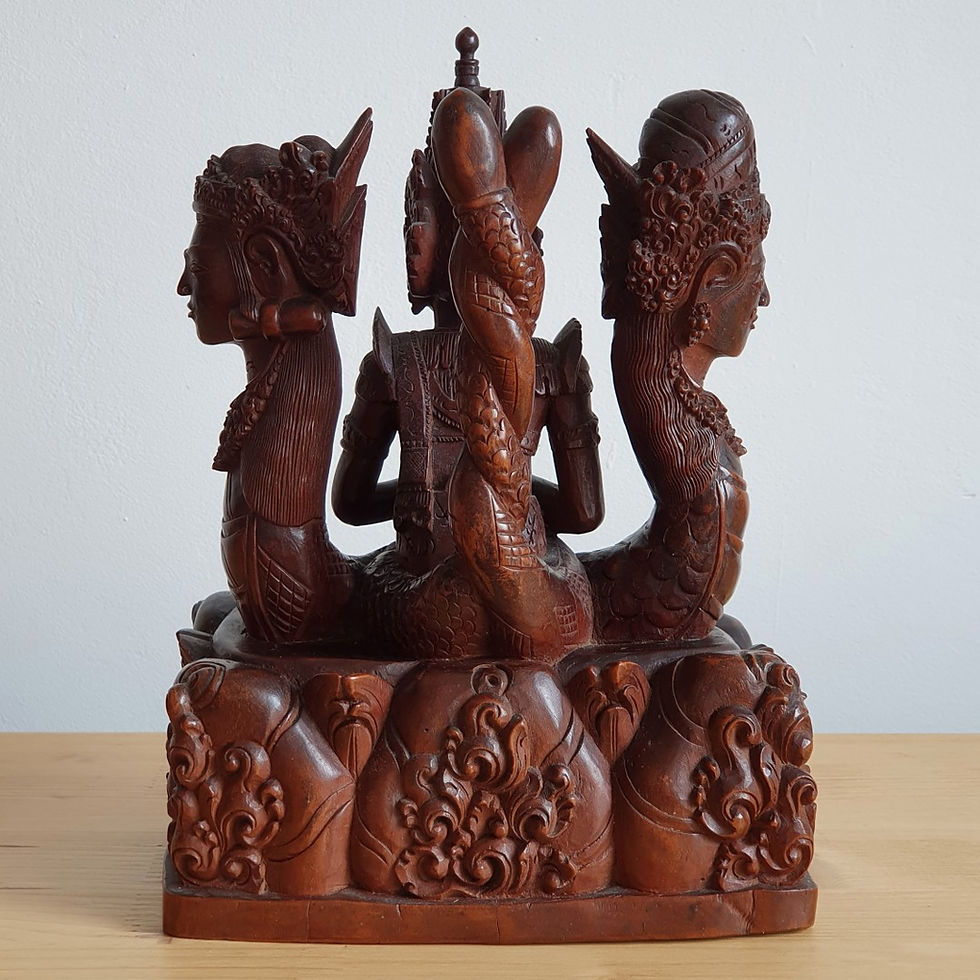
This second sculpture depicts Kashyapa, Kadru’s husband and the father of the nagas. He is shown from the waist up, emerging from a rectangular, four-sided pedestal decorated on all four faces. His static, symmetrical posture—again marked by a gesture that could be a mudra—evokes that of an ascetic or a sage in meditation. Two human-faced nagas embrace their father’s waist. On the back of the sculpture, their bodies coil around each other in a kind of braid that could express the idea of a complementary duality. The fact that the two nagas display attributes generally associated with the feminine on the one hand (cylindrical, subeng-type ear ornaments on the naga to Kashyapa’s left) and the masculine on the other (triangular ear ornaments and a moustache on the second) would be consistent with this hypothesis.
The use of a heavy, reddish wood covered with a light patina, the static and symmetrical composition, the abundance of small ornaments, and the type of faces are characteristic of traditionally inspired sculptures, most of which date from the first half of the 20th century. The patina shows signs of wear, but the forms are intact, and although the details are less finely rendered than in the sculpture depicting Kadru, it is once again the rarity of the subject that makes this piece distinctive.
* See the account of this episode in this article from the Bibliothèque Nationale de France (French-language resource).


Comments