
What Criteria for Collecting Modern Balinese Sculpture? (1/2)

Updated: Aug 6

Collecting is a passion that involves making choices and compromises. When one sets out to collect modern Balinese sculpture, the question of what to choose is all the more difficult because the available pieces come from a context marked by several decades of remarkably abundant craft production. Among the vast quantity of objects now offered on the resale market, how does one distinguish those that deserve particular attention?
There are many ways of collecting, and one could simply answer that, as a matter of principle, a piece that appeals to us is a good choice. But with experience, one’s knowledge of periods and styles becomes more refined, and one may want to move beyond this intuitive approach and develop a set of clearer, more stable criteria.
Of course, I do not claim to offer here a model that would apply to all collectors: my criteria primarily reflect my own perspective as a Western amateur. Many of them are fairly general, and I would apply them just as readily when choosing any other sculpture, regardless of its provenance. Rather than forming a system, then, they constitute a personal tool that helps give my collection its own identity. What follows is above all an attempt to make these criteria explicit—but perhaps it may also provide beginning collectors with a few points of reference, while giving more experienced collectors an opportunity to put their own criteria into perspective.
Harmony of Form
The dictionary defines harmony as the agreement of different elements arranged so as to form an ensemble that is pleasing to look at. Applied to sculpture, this notion first leads us to consider the lines that structure its volumes. There are the lines created by the outer contours—that is, the way the forms stand out against the surrounding space. They define the solids—the sculpted volumes—but also the voids that surround them or occur between them. There are also the inner contours, where two parts meet, such as the line separating the torso from the arm when the latter is held against the body. Finally, some lines are merely suggested by shallow incisions in the surfaces, for example to evoke the folds of a garment. To speak of harmony is therefore to consider the relationships between all these lines: their correspondences, their contrasts, and the rhythms they produce.
To some extent, a comparison of the two wayang-style sculptures reproduced below helps illustrate this idea.
In the female figure, several features contribute to an impression of harmony. The position of the clearly distinct parts of the body appears both natural and immediately legible. The relationships between solids and voids have clearly been taken into account by the maker of the model. Seen in profile, the bend of the left leg creates a balanced triangular void that fits elegantly into the silhouette, which itself is contained within a triangle with similar properties. The contours display varied sequences of straight lines—the limbs and torso—and fairly short but particularly fluid curves—the rounded forms of the headdress and the breast. Finally, on the base, the slightly modulated straight lines separating the fingers contrast elegantly with the complex arrangement of the many curves forming the edges of the fabric.
The male figure is not without character, but harmony of form is not its main quality. The arrangement of the arms and legs creates an impression of congestion, as though the carver had struggled to fit this figure, seated in a complex position, into the piece of wood from which he was working. In profile, some inner contours—the boundaries between thigh and calf, thigh and torso, and arm and torso—run alongside one another in somewhat monotonous parallel lines, while the contours lack the same elegant variety in the succession of curves and straight lines.
The Quality of Definition of the Forms
This criterion is closely related to the previous one, since the harmony of forms—the way in which they work together—is clearly connected with the qualities of the individual forms themselves. However, it can happen that the overall effect is more successful than the detail of the individual parts.
Some parts are notoriously more difficult to carve, and examining them can help assess the quality of a sculpture. In the representation of the human body, particular attention can therefore be paid to faces, ears, feet, and hands. Here again, a comparison of the two figures already mentioned is revealing.
The same apparently simple method, used in many sculptures now associated with the wayang style, is employed here to represent the hands: elongated fingers separated by three modulated incisions in a raised surface, with a double notch indicating the beginning of the fingernails. In the female figure, this method results in a delicate motif whose form reflects attention to anatomical reality, as can be seen in the discreet suggestion of the phalanges through the inflections of the incisions, as well as in the treatment of the junction between the thumb and the back of the hand. By contrast, the fingers of the male figure look like soft, slightly swollen tubes. The thumbs, which curiously become thicker towards their tips, are attached to the hand rather carelessly. Finally, the continuity of the fingers of the right hand, on either side of the left thumb positioned above them, appears somewhat approximate.
Of course, when a sculpture is clearly intended to achieve a degree of realism—a more complex notion than it might appear; I shall have to write an article about it—the coherent rendering of carefully observed anatomical qualities would logically deserve particular attention in the definition of the forms. This is, for example, something one might expect from the busts produced during the first half of the twentieth century, as I explain in this article.
Quality of Finish
Good quality of finish can be assessed, among other things, by the polish of the surfaces and the absence of tool marks. There are, however, exceptions, particularly when engagement with the raw material takes precedence over the pursuit of a traditional “finished” appearance, as is often the case with tjokotism. The tool mark then becomes part of the sculptor’s visual language and contributes to the expressiveness of the result.
Balinese figures inspired by traditional subjects often contain a great many ornamental details, particularly in clothing and headdresses. The precision and care devoted to these details can be regarded as evidence of a highly accomplished finish.
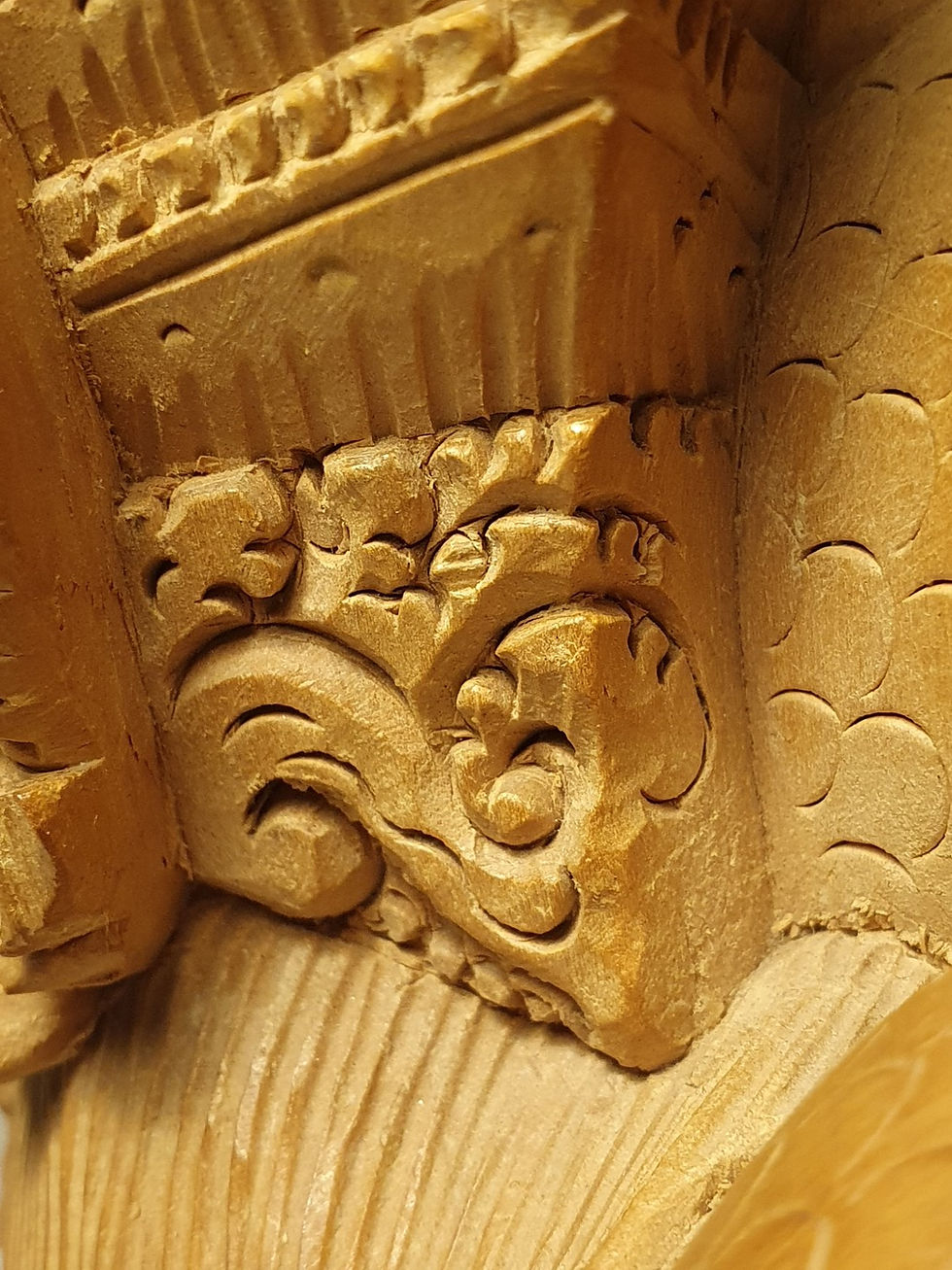
The photographs above are close-ups of a good-quality piece. They nevertheless show areas that are not very visible or are difficult to reach, and which the carver did not want—or was not able—to treat with the same precision as the rest. The ornaments are barely sketched out (photo 1), or defined rather roughly (photo 2).

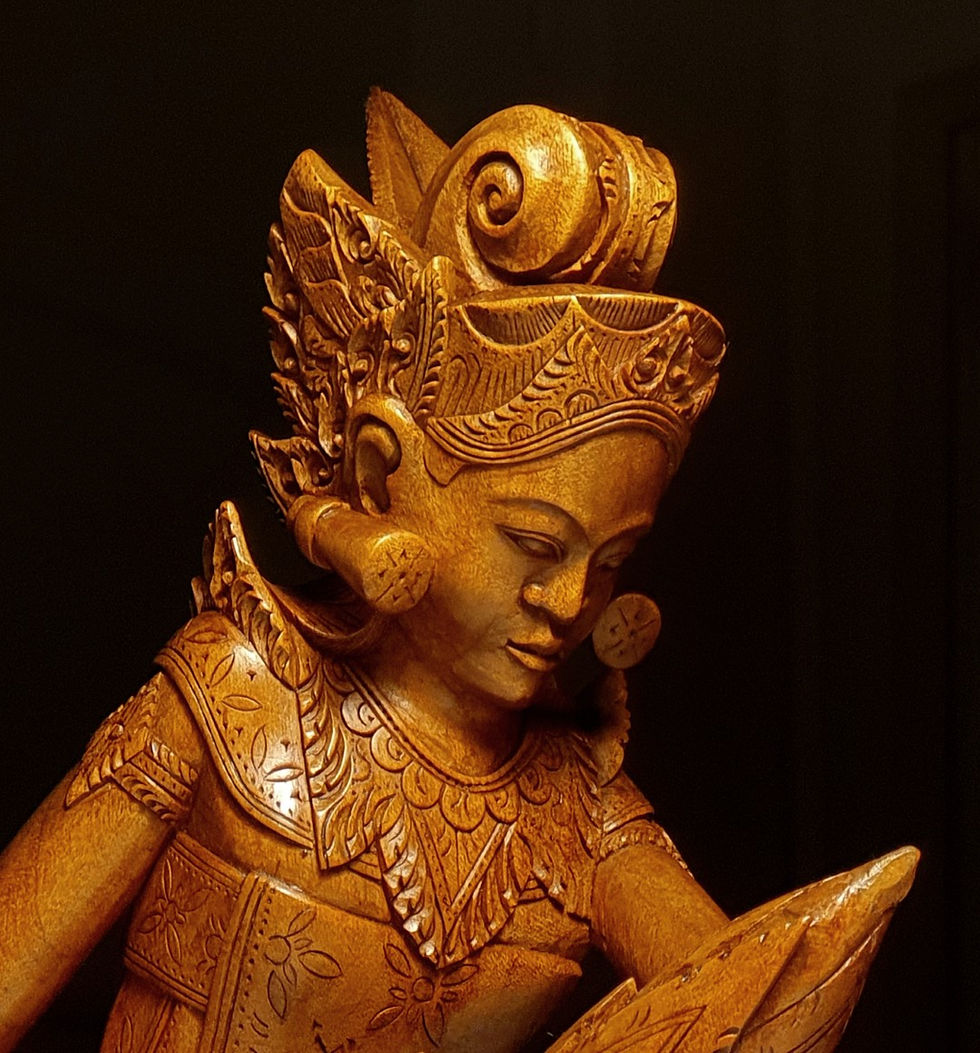
This other photograph shows an ornamental necklace on the front of the same piece. The difference is obvious: the carver treated this part with considerably greater precision and care.

Another example of fine treatment of ornamental elements is the headdress of the Vishnu in the Njana Tilem Gallery, which I have already discussed here. The elements are varied and rendered meticulously, while the carving gains in complexity through the addition of pronounced curvatures—concave and convex effects—in depth.

In this other image, one can appreciate the refinement of Dewi Uma by I Made Polih, in which the ornaments unfold in a dense profusion of fine arabesques.

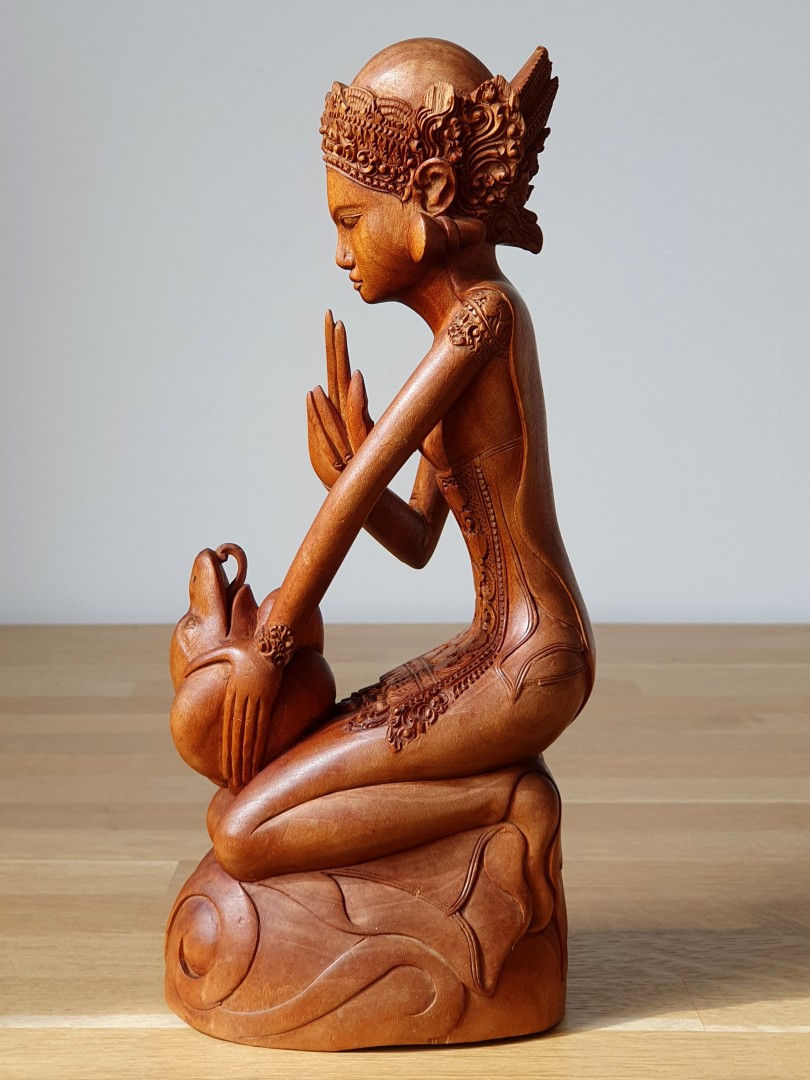
One final observation on this point: some collectors sometimes associate the quality of ornamental work with the depth of the carving. This criterion can be useful in some cases, but I would not make it a general rule. Other forms of shallow carving can combine elegance and complexity, as shown by the headdress of this figure of a nymph or goddess.
Complexity vs. Simplicity
It is tempting to link the value of a sculpture to the complexity of its forms and, from there, to the amount of work the carver devoted to it and the technical difficulties that had to be overcome in its execution. These are legitimate criteria. But they cannot be sufficient, nor can they be applied with the same rigour in every case.
First, because apparent complexity does not necessarily go hand in hand with sufficient quality according to one or another of the criteria discussed above. Secondly, because certain approaches or motifs naturally call for the use of more complex forms than others. This is particularly true of representations of dancers, mythical figures, and traditional or modernised figures, often endowed with numerous attributes and ornaments, like the pieces whose details we examined in the previous section. It should also be added that when these representations illustrate stories drawn from the Hindu tradition, they frequently incorporate a narrative dimension, which quite logically tends to encourage complexity in the compositions and probably justifies specific expectations in this respect when collecting this type of sculpture.
These qualities can be found in wayang-style sculptures when they depict deities or illustrate myths. But the general characteristics of this style, together with the importance it gives to motifs drawn from everyday life, often lead carvers to favour harmony of line through simple forms tending towards geometric abstraction. This form of stylisation allows for a marked departure from the reality of observed forms. While the best examples display a grace achieved through a subtle combination of straight lines and curves—as in the female figure examined above—a more rustic and more rugged form of stylisation can, in my view, be equally interesting.
Take, for example, this small wayang-style figure of a legong dancer:

The accessories and pose reproduce a familiar formula, and one may sense a certain naivety in the geometric interpretation of the forms and in the way they relate to one another. But the consistency with which these characteristics structure the figure as a whole gives it an original quality, which can be appreciated as a coherent appropriation of the characteristics of the wayang style.
The category to which the criterion of complexity applies least naturally is probably that of figures with full, rounded forms. As we have seen with several pieces already discussed on this site, this is a tendency that develops through the pursuit of fullness in simple volumes, in a harmonious dialogue between the fluidity of the carved forms and the effects obtained by allowing the structure of the wood to express itself. But for a carver, the economy of means required by this mode of stylisation presumably represents a challenge every bit as demanding as the formal complexity characteristic of the traditional approach.
Period, Subject Category and Style
Preferences concerning the period, subject category, or style of a sculpture are essentially a matter of personal taste. It is therefore difficult to derive from them indications that could serve as general rules. Some collectors are more selective than others in their choices, focusing their collections on a particular period or a narrowly defined type of subject, while others prefer to embrace greater diversity. For my part, I collect relatively few narrative compositions belonging to the modernised traditional repertoire—not only as a matter of taste, but also because this type of sculpture is poorly represented on the market to which I have access.
Modernised traditional figures were produced in large quantities as Balinese craft production became increasingly widespread, and they generally attract my attention only when they stand significantly above the average, whether through the unusual nature of the subject or through the quality of the execution. From what I have observed, figures belonging to the full-form or elongated styles are not currently highly sought after, unless they bear the signature of a particularly renowned sculptor. Yet these categories offer, in my view, good opportunities for collectors who are able to appreciate their qualities independently of the sculptor’s reputation.
Many consider the period from 1930 to 1940 to have been something of a golden age of modern Balinese sculpture. This view is probably not without foundation: the development of the wayang style produced bold and accomplished works, while busts from this period, when they display close observation and careful execution, rightly rank among the most sought-after pieces. But the elevation of a particular period can also reflect a more general phenomenon, one that feeds on itself: the more a category is fashionable and sought after, the more it attracts new enthusiasts and influences the way the entire body of related work is perceived. The current enthusiasm for the wayang style seems to illustrate this mechanism well: demand sometimes drives prices far beyond what the intrinsic quality of many pieces would justify, including pieces that are merely average.
The continuation of this reflection will appear in a forthcoming article.


Comments