
What Criteria for Collecting Modern Balinese Sculpture? (2/2)


In a first article, I reviewed a series of criteria that can help guide the selection of a modern Balinese sculpture: harmony of forms, the quality of their definition, the quality of the finish, complexity, period, subject category, and style. Here is the continuation of that reflection, with four additional criteria.
Rarity of the Motif
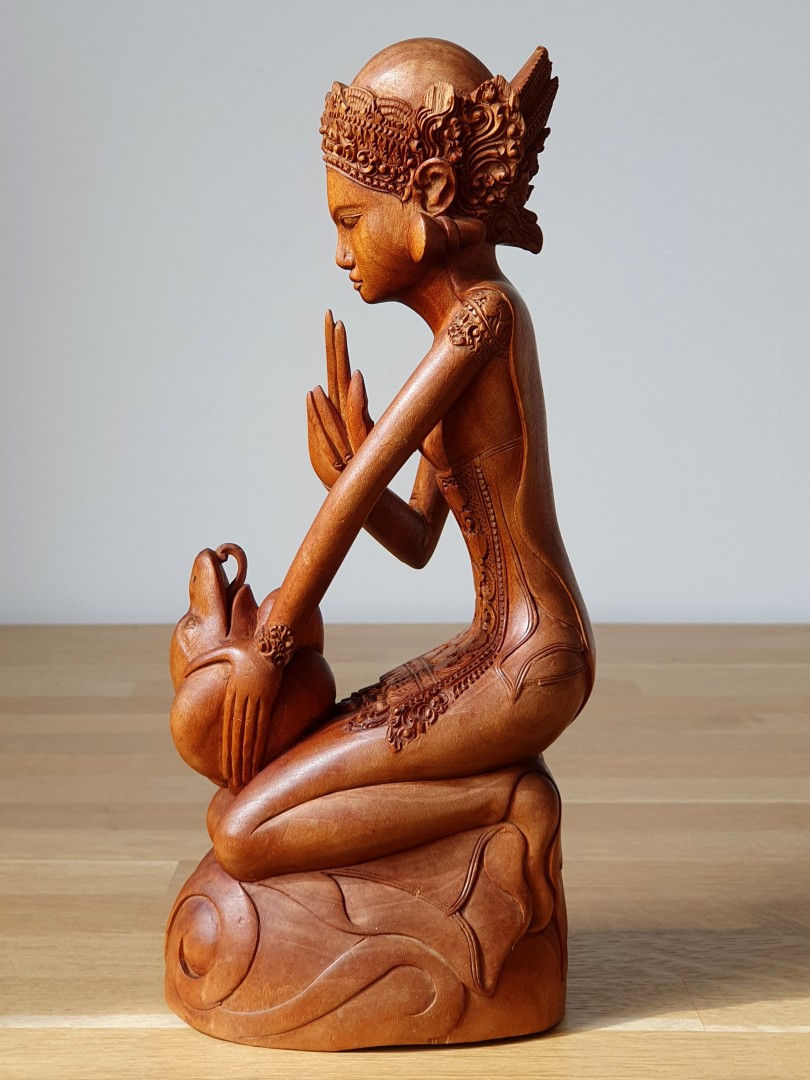
Collectors generally seek pieces that stand out through the rarity of their motif. In reality, most modern Balinese sculptures were produced on a serial basis, through the reproduction of a type. By “type,” I mean a particular motif (a young woman seated on the ground, a kneeling legong or janger dancer, the bust of an elderly man with a weathered face and wearing an udeng, a deity seated on a lotus-shaped throne, a couple kneeling to represent Rama and Sita, etc.) with recurring characteristics (features, posture, accessories or attributes...) and functioning as a standard and model. Thus, a well-executed piece that departs significantly from the type to which it belongs—or, better still, one that does not seem to correspond clearly to any identifiable type—will often be of greater interest.
In the photograph at the top of this article, the small wayang-style figure—a little girl kneeling in a pensive attitude—is satisfactorily executed, though not without some awkwardness. In my view, its interest lies mainly in the fact that the motif does not correspond to a usual type. Does that make it a unique example? Even after seeing a great many sculptures, it is important to remain cautious: the fact that one has never encountered a given motif does not necessarily mean that it is unique. It may simply have been reproduced in smaller numbers.
Conversely, a piece that conforms to a usual and highly codified type does not necessarily lose interest if it possesses certain qualities. The rakshasa figure (a kind of protective demon) beside the young girl reproduces a motif that has been repeated many times—almost identically—since at least the 1930s. The details traditionally adorning these figures vary considerably in fineness from one piece to another. This one, however, is certainly an early example, probably from the first half of the 20th century. Not only are the details, extremely fine on this figure of barely 15 cm, rendered with great mastery, but the fact that the piece was carved from uniformly black, silky ebony adds further to its interest.
The Properties of the Material and Surfaces
One can distinguish sculptures that leave the properties of the wood visible from those with a patina.
I can say that Balinese sculptures—and the Balinese carvers through them—have taught me to look at the properties of wood and to appreciate the way carved forms can engage with them. It is in the elongated or full-bodied works of the second half of the 20th century that carvers seem to have experimented most readily in this respect. They took advantage of the diversity of woods used: crocodile wood, suar, jackfruit, hibiscus... woods with naturally varied grain and coloration provided a fertile basis for these interactions between form and material. I have discussed this aspect in particular in the articles on the sleeper attributed to Satriawan and the embracing couple by Purne. To give just one more example, the small elongated-style figure shown below will probably not appeal to every collector—and it is true that there is a certain simplicity to this emphatic play of curves and countercurves. The carver has nevertheless made very skillful use of this dark wood (sonokeling or Macassar ebony), whose reddish veins harmoniously follow the vertical, flame-like movement of the figure.

As for the application of a patina, it was clearly common in the first half of the 20th century and continued thereafter. Generally brownish in tone, it most often covers lighter woods whose surface, it seems, was not considered worthy of being left as it was. A fine patina can essentially produce two kinds of effects: either a chromatic homogenization of the surface, making it more or less glossy, or a nuanced enhancement of the patterns already present in the wood, giving it a more flattering appearance. The question then is whether these effects have been achieved successfully and whether they have been sufficiently preserved over time.
Condition
Some collectors are interested only in pieces in perfect condition. That is not the case for me. I do not automatically rule out a damaged piece if it has other notable qualities, unless the damage is so extensive that it irreparably disfigures the motif. Minor defects (cracks, losses, scratches, impacts...) seem normal and acceptable to me in objects that are several decades old, have travelled from one continent (and often one climate) to another, and have sometimes had a eventful history.
For pieces that I consider particularly interesting, I sometimes accept significant damage, provided that it can be restored. When this is the case, I call on a professional restorer. The cost is certainly substantial, but it is fully justified by the quality of the result. Below, one can see the condition in which I acquired Tulak’s Sarasvati—with the head detached but, fortunately, completely preserved—and the result after the restorer’s intervention.

As for period restorations, which are fairly common on Balinese sculptures, they do not diminish their value in my eyes. They are part of the history of the piece and testify to the carvers’ skill in solving problems encountered in working wood. Below, at the back of the head and neck, one can see a period restoration on the bust of the elderly man discussed in this article.

The Identity of the Carver and Authenticity
The presence of a signature is always interesting, particularly when it is that of a recognized carver. I do not, however, consider this criterion to be paramount, for several reasons: first, because excellent carvers worked anonymously; second, because not all masters, regardless of their degree of recognition, systematically signed their work; and finally, because a piece bearing the name of a recognized carver may in fact have been made within his circle, without this necessarily being a fraudulent practice. The status of the signature seems, in fact, to have been fairly fluid in the development of modern Balinese sculpture.
In light of this last point, one may wonder how the criterion of authenticity comes into play. What, under these circumstances, would constitute a sculpture of doubtful authenticity? In fact, the question is quite relevant on the resale market, where it is not always easy to verify whether the origin and date of the piece being offered actually correspond to the seller’s claims. Particular caution is probably warranted with older wayang-style pieces, which are more sought after and therefore more exposed to this kind of uncertainty. The question of authenticity would nevertheless deserve an article of its own.


Comments